
NEWS
NEWS
-
![[Latna Saga: Survival of a Sword King] Sweeps # 1 Spots in the Biggest Webtoon P...](/uploaded/webedit/2606/4b133335331f9b4e4582c9bf286f2bcd1b36935a.jpeg) Red Dog’s first-ever webtoon series 'Latna Saga: Survival of a Sword King' swept 1st place spots immediately upon release in Korea’s KakaoPage, Japan’s Piccoma, and China’s Kuaikan Manhua!Starting off the New Year with its release on KakaoPage on January 1st, 2020, 'Latna Saga: Survival of a Sword King' became a hot topic when it shot up to first place for young teen male manhwas as it was getting serialized. The webtoon began its overseas serialization on China’s largest webtoon platform Kuaikan on June 25th and then on Japan’s largest webtoon platform Piccoma on July 1st. Thanks to fan support from all over the world right after its serialization, the webtoon ranked in 1st place for 3 different criteria (Young Adult, Young Male Teen, Korean) on Kuaikan, and ranked in 1st place for 2 criteria (Overall, Fantasy Genre) on Piccoma.China’s Kuaikan is a webtoon platform that recently underwent rapid growth given the huge continent-wide market. All the representative webtoons of Korea, China, and Japan have entered the platform and are now engaged in a fierce battle. On the other hand, Piccoma is a Japanese webtoon platform that it is operated under the South Korean corporation Kakao, and thanks to various hit webtoons from Korea, the platform is currently the leader in the latest boom of the K-Webtoon wave. Despite being surrounded by such strong competition, 'Latna Saga: Survival of a Sword King' has achieved a magnificent feat. Please keep cheering on the webtoon!China’s Kuaikan, Screen Showing Number 1 Rankings in 3 Criteria(From the left, Young Adult Manhwa Ranking, Korean Manhwa Ranking, Young Male Teen Manhwa Ranking)Japan’s Piccoma, Screen Showing Number 1 Rankings in 2 Criteria (From the left, Overall Ranking, Fantasy Genre Ranking)2020-07-10
Red Dog’s first-ever webtoon series 'Latna Saga: Survival of a Sword King' swept 1st place spots immediately upon release in Korea’s KakaoPage, Japan’s Piccoma, and China’s Kuaikan Manhua!Starting off the New Year with its release on KakaoPage on January 1st, 2020, 'Latna Saga: Survival of a Sword King' became a hot topic when it shot up to first place for young teen male manhwas as it was getting serialized. The webtoon began its overseas serialization on China’s largest webtoon platform Kuaikan on June 25th and then on Japan’s largest webtoon platform Piccoma on July 1st. Thanks to fan support from all over the world right after its serialization, the webtoon ranked in 1st place for 3 different criteria (Young Adult, Young Male Teen, Korean) on Kuaikan, and ranked in 1st place for 2 criteria (Overall, Fantasy Genre) on Piccoma.China’s Kuaikan is a webtoon platform that recently underwent rapid growth given the huge continent-wide market. All the representative webtoons of Korea, China, and Japan have entered the platform and are now engaged in a fierce battle. On the other hand, Piccoma is a Japanese webtoon platform that it is operated under the South Korean corporation Kakao, and thanks to various hit webtoons from Korea, the platform is currently the leader in the latest boom of the K-Webtoon wave. Despite being surrounded by such strong competition, 'Latna Saga: Survival of a Sword King' has achieved a magnificent feat. Please keep cheering on the webtoon!China’s Kuaikan, Screen Showing Number 1 Rankings in 3 Criteria(From the left, Young Adult Manhwa Ranking, Korean Manhwa Ranking, Young Male Teen Manhwa Ranking)Japan’s Piccoma, Screen Showing Number 1 Rankings in 2 Criteria (From the left, Overall Ranking, Fantasy Genre Ranking)2020-07-10 -
 Red Dog Culture House successfully secured an investment of KRW 10 billion (Around USD 10 million) from the global content company SmartStudy (CEO Minseok Kim) and venture capital SmartStudy Ventures (CEO Hyunsong Lee).SmartStudy is famous for being the company behind the global IP Pinkfong ‘Baby Shark’ which became an unprecedented sensation in the world’s market at large.The company is currently expanding its territory into more areas of business including YouTube animations and product licensing. Red Dog and Baby Shark as a duo! Excited to see what these two will be creating together!2020-06-10
 -
![[The Haunted House: The Sky Ghost VS Jormungandr] Ranks an All-time 4th in the B...](/uploaded/webedit/2606/50205d584a09627304c08c61a1c8f6589abf50b6.jpg) The animated film , which Red Dog participated in the production of, scored an approval rating of 8.7/10 and reached 894,356 in ticket sales, ranking in all-time 4th place in the box office for South Korea’s animated films.The Haunted House is yet another groundbreaking feat for Korean animated films. Keep giving the film your love and support, guys!2020-02-20
The animated film , which Red Dog participated in the production of, scored an approval rating of 8.7/10 and reached 894,356 in ticket sales, ranking in all-time 4th place in the box office for South Korea’s animated films.The Haunted House is yet another groundbreaking feat for Korean animated films. Keep giving the film your love and support, guys!2020-02-20 -
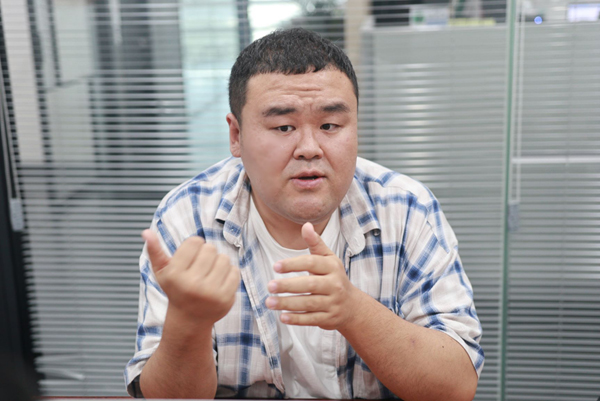 Q. Could you briefly introduce Red Dog Culture House?Hello, we are Red Dog Culture House, producing not only 2D animation but also webtoons and web novels under the slogan “Korea’s Favorite Subculture Brand.”Through creating subculture content, we strive to become a studio recognized in the global market.Q. I understand that you have previously produced animations based on games as well.We have produced a number of game promotional videos, including Overwatch, TalesWeaver, and Hero Cantare, which many webtoon fans may be familiar with. Since they were PVs, they were relatively short animations, usually around a minute and a half. As for a full animation series based on a game, we worked on Ar:pieL, a title created by Nexon.Q. I think many people who are hearing about Red Dog Culture House for the first time may know you through this work. Could you introduce the piece “Good Hunting”?It was a project planned by Netflix and overseen by Blur Studio, where director Tim Miller is based. For the anthology series Love, Death + Robots, studios from around the world and directors with unique creative identities were matched to individual shorts, and this was one of the works commissioned through that process.In our initial meetings, they said they were aiming to create “animation for adults,” which we found extremely interesting. Animation production is demanding work and it is easy to burn out, so we approached the project thinking it would allow us to work on something especially engaging.To be honest, after finishing production and before the release, we had watched it so many times during the process that it became hard for us to feel confident about whether it had truly turned out well. But once it was released, we received dozens, even hundreds of times more feedback and support than we had expected, which made us very proud. It was a project that made us feel that continuing to work on projects like this would be beneficial in many ways if the opportunity arises.Q. When you say you found the proposal “interesting,” was that partly because the Korean animation market is largely centered on children’s animation?There is certainly some truth to that. However, we are a studio that has always wanted to work on projects aimed at slightly older audiences rather than children’s animation, so our team is made up of people whose strengths lie more in works for older age groups. Because the environment in Korea has not produced many projects where we could fully demonstrate those strengths, we ended up doing a lot of work in the game sector.In that situation, even though it was an overseas project, we were intrigued simply by the idea of making a work that contained a story adults could enjoy. To be honest, when we first received the script, it felt very unfamiliar. Internally, we even said, “Wow, they really do make exactly what they want to make” (laughs). And in a way, that made it even more appealing to us.Q. The original author of the script you just mentioned is actually world-famous. Since “Good Hunting” is based on a work by Ken Liu, the first writer in the world to win the Hugo, Nebula, and World Fantasy Awards, I imagine adapting it must have felt quite burdensome.To confess here, we actually did not know that until we had already received the script and begun production (laughs). I think none of the people involved in the project knew either. I myself am not deeply versed in science fiction, so I didn’t know. It was only after the release, when I saw the reactions, that I realized it was a work by a very famous author. So in that sense, we were able to produce it without feeling too much pressure.Even if we had known, though, I think the pressure would ultimately have been the same. Blur Studio and Netflix reviewed everything so meticulously that there was already plenty of tension from that alone. They examined the work extremely carefully.Q. How did your collaboration with Netflix proceed? I’d like to hear about the production process, starting with whether you chose the work yourselves or whether it was assigned to you.When the project was first introduced to us, we were told that it would be produced using various techniques, including both 2D and 3D. They said that about two or three of the pieces would likely be done in 2D, and they provided us with scripts.The work we ended up producing through that process was “Good Hunting.” Although a small amount of 3D was incorporated to express the steampunk world, it was produced mostly in 2D. The production was done 100% digitally. In longer series productions, it is often unavoidable to outsource some paper-based animation work externally, but since “Good Hunting” was a short 17-minute film, we were able to handle it internally and produce it entirely digitally.Throughout the process, we communicated regularly with Blur Studio. There, director Tim Miller reviewed the scripts, and based on them, Blur played the role of a hub by matching each work with a director and studio suited to lead the project and facilitating the collaboration. That is how we came to produce the work together with director Oliver Thomas.Netflix became directly involved in discussions about review and approval once the film began to take shape. Before that, we mainly continued communicating with Blur Studio and director Oliver Thomas throughout the production. Since they were based in the United States, we held video meetings, starting in the Korean morning and aligning with the American evening, and kept the process moving that way.Q. I’m curious about what differences there were between producing a short animation and creating teaser animations for games such as Overwatch, TalesWeaver, Ar:pieL, and Hero Cantare.First of all, the directing style itself differs between a series and a promotional video. A PV has to deliver strong visual impact within a very short amount of time, whereas a series must carry narrative and build a story effectively, so compared to a PV, it also contains more restrained and static aspects in its direction.The production itself is also different. PV videos are usually made to promote a game, so they naturally center on the game’s characters. They are created in a way that highlights those characters as effectively as possible. In a series, on the other hand, the character design tends to be made somewhat simpler. If you are producing a 12-episode series, that can mean around 5,000 to 6,000 cuts, and no one person can make all of that alone, so the designs have to be practical and suitable for multiple people to work on without strain. PVs are usually produced by around three or four people, up to about ten at most. Since quality is especially important in PVs, the team is composed of people who can handle that level of quality.That does not mean a series simply lowers the level of difficulty or has lower quality. Rather, it means allocating resources wisely—keeping some parts simple so that in the scenes that truly need to be spectacular, the production can explode with a level of quality that goes beyond even a PV.Q. From the perspective of a creator, what kind of work feels “more enjoyable” to you?I think each person finds enjoyment In slightly different aspects of the work. with PVs, one advantage from a creator’s perspective is that the final result comes out quickly, so you can immediately feel the audience’s reaction. on the downside, However, Because these videos are made to promote a game, the game itself is the main focus, so most of the feedback tends to center on the game rather than on the Animation itself.A series, on the other hand, tends to receive a lot of feedback not only on the visuals but also on the narrative, which is very encouraging from a creator’s point of view. The downside is that a long time passes between finishing production and the actual release, so the waiting part can feel a little frustrating.Q. Team Leader Jun-ho Kim of Red Dog Culture House won the Emmy Award for Outstanding Individual Achievement in Animation for “Good Hunting” in the Background Designer category. Congratulations. What does receiving an Emmy mean for an animation studio?To be honest, the name “Emmy Award” itself carries tremendous weight. Of course, working with an American company like Netflix may have helped, but even so, simply standing out among the vast number of works released around the world makes it an incredibly significant award in our view.There really are not that many awards available specifically to animation creators, even on a global scale. And among them, the Emmy is certainly one of the biggest honors an animation creator can receive, so winning one of those awards holds tremendous meaning for us. To be honest, we thought it would already be wonderful just to be nominated, but we had not even heard that we were nominated before the news of the win arrived, so we were truly shocked.We believe we were given a wonderful opportunity by being able to participate in the production of such a strong work. Winning the background design award is a great honor, but we also hope that not only us, but other Korean studios as well, will continue striving to create works that can earn awards like this.Q. I’m curious about the process of combining real-world places (or places that once existed) with the steampunk world of “Good Hunting.” Some broad details have been shared on social media, but I’d love to hear how those ideas were developed and concretized.Basically, among the reference works we looked into within the range of what we could think of, there were films such as Katsuhiro Otomo’s Steamboy. In addition, director Oliver Thomas sent us reference materials he had used while developing the storyboard and structure, and our designers expanded on those as a foundation.Even so, the biggest concern in that process was deciding how much to add and how much to take away. We live in a world overflowing with references (laughs), so there was certainly no shortage of material to look up and study. The real challenge was making something that could plausibly exist within reality, yet still feel strange and original at the same time.Despite that difficulty, our design team brought it to life brilliantly, and it was very satisfying to watch. The final result turned out exceptionally well. In particular, the depiction of Hong Kong’s skyscrapers was not without references, but the team succeeded in creating an atmosphere that felt even more convincing than the source materials. I think that is why we were able to successfully align the overall mood with the story, the historical backdrop, and the narrative.Q. I saw the news that Season 2 of Love, Death + Robots has been confirmed. I understand that director Yeo In-young of the Kung Fu Panda series is serving as supervising director for Season 2. I’m curious whether Red Dog Culture House is also participating. Is there anything you can share?It is not really something we can decide ourselves… (laughs). We also learned about Season 2 through news articles. I imagine that even after production is confirmed, it will still take some time before the actual creators are connected and the work begins. If we do happen to receive a call, we would certainly hope to deliver the best possible result.Q. In addition, Red Dog Culture House has recently begun participating in the production of webtoons and web novels in earnest. Could you introduce the works currently being serialized and the projects now in production?The serialization of writer Hong Jung-hoon’s novel The Dragon God’s Game began on KakaoPage on August 9, and its animated PV has also been released. In addition, writer Neotype’s Behold! How to Rewrite the Emperor of Another World is scheduled to open on KakaoPage early next month as a wait-for-free title. We are also moving toward the release of the webtoon adaptation of writer Lim Kyung-bae’s Latna Saga: Survival of a Sword King, which is currently scheduled for around the end of this year.For now, we are primarily developing works with animation adaptation potential, but we are trying not to impose limits in terms of subject matter or genre. Nothing has been finalized yet, but we are reviewing works across a variety of genres, including romance and science fiction, as well as our own original projects. Since animation remains our core focus, the main thing we consider in webtoons and web novels is what kind of appeal each work would have if it were adapted into animation.Q. When deciding to produce a webtoon or web novel, what criteria do you use in evaluating a work?First and foremost, the key factor is whether the work can be adapted into animation. As I mentioned, our strength lies in being a “subculture” brand, so we want to work on projects that can appeal to fans who primarily watch animation. At the same time, we are not aiming only at fans of Japanese animation; we are also discussing works that would allow us to experiment with a variety of styles, much like what we attempted with Love, Death + Robots.Q. It feels quite distinctive for an animation studio to participate in webtoon production. I’d like to hear your thoughts on the differences and similarities between webtoon scroll-based direction and animation.I have been working in animation production for nearly twenty years myself, but webtoons… they are difficult (laughs). In my view, while the scroll format can certainly express things like camera movement effectively, what I felt at a fundamental level was clearly different. Since the mode of expression itself is different, I also felt there are clear differences in direction. So we are trying various approaches, but I think we will need to put in a great deal of effort.That said, I do believe there is potential to make them similar in terms of the production system. Animation has long had a highly segmented production pipeline, and in webtoons as well, as quality standards rise, more tasks are emerging that cannot be handled by one person alone, which is leading to the growth of studios. Since animation has already been produced that way for a long time, I think our studio can also draw from animation’s production system to improve quality through a collaborative creation system while also distributing the workload more stably.Q. It may be difficult to say right now, but when do you think we might be able to see the first case of a Red Dog-produced work expanding from web novel to webtoon to animation?For now, we believe that whether it is web novels or webtoons, a certain body of works needs to accumulate first. We think that in order for meaningful animation projects—which require significant capital investment—to emerge, there first need to be works that achieve a certain level of success. Of course, we would love for every work to develop that way, but things do not always happen simply because we hope they will.Through IPs such as webtoons and web novels, we intend to focus on growing those IPs so that we can expand our business by producing animation together with various partners in other fields. If that leads to many successful works, we believe that would be the most desirable direction for us.In that process, we are also envisioning hybrid content that combines the strengths of animation and the strengths of webtoons in new ways. We are searching for IPs that would be well suited to that approach, and we also believe that, in order to ultimately move toward animation, both webtoon readers and existing animation fans may need some time to become more familiar with animation based on webtoon originals. In other words, we may need to build that habit gradually.Ultimately, we believe animation is the combination of planning and technology. In terms of technical capability, since we are leading projects ourselves, we believe we are going through the stages necessary to prove that capability. Planning, on the other hand, is something we believe we can build up through web novels and webtoons. If we are able to secure both planning and technology, then we believe we can create truly strong animation works.Q. Lastly, would you like to share a message for the fans who will continue to follow Red Dog Culture House’s work, and for the readers who have supported you so far?Even now, and going forward as well, we have many strong works that we are producing and preparing to present. Personally, I hope these works can create a major impact for our fans, much like Good Hunting did. We will continue to return with projects that allow us to demonstrate our capabilities one by one.Our webtoons and web novels are also getting off to a promising start, so we believe that by the end of this year or sometime next year, we may be able to connect more closely with webtoon and web novel readers as well. Up to now, because we have mainly worked on outsourced animation production, we feel there have been relatively few opportunities to communicate directly with the people who watch our work. As I mentioned earlier, since our goal is to become “Korea’s greatest subculture brand,” we will work harder to approach and communicate more actively with the people who love our works. We will continue striving to create content that you can passionately enjoy with an open heart, so we hope you will look forward to it. Thank you.2019-08-30
 -
![[Good Hunting] won the 71st Emmy Award.](/uploaded/webedit/2606/53f257d287f705f1630d664914311aa2f4978cfe.jpg) The Television Academy announced today the juried award winners for the 71st Emmy Awards in categories from Animation, Choreography, Interactive Programming and Motion Design. The juried awards for these categories will be presented at the 2019 Creative Arts Awards ceremonies on Saturday, Sept. 14, and Sunday, Sept. 15.In Outstanding Individual Achievement In Animation, there were seven first-time winners and one second-time winner from programs across two platforms, YouTube and Netflix. Adult animation anthology Love, Death & Robots earned four awards, followed by VR short Age of Sail with three and kids’ adventure Carmen Sandiego with one.A full list of winners is available online. A two-part presentation ceremony for the Creative Arts Emmy Awards will be held September 14 and 15 at Microsoft Theater in Los Angeles, broadcast Sept. 21 at 8 p.m. on FXX.Age of Sail • YouTube • Google Spotlight Stories and Boathouse Studios • Céline Desrumaux, Production DesignerAge of Sail • YouTube • Google Spotlight Stories and Boathouse Studios • Bruno Mangyoku, Character DesignerAge of Sail • YouTube • Google Spotlight Stories and Boathouse Studios • Jasmin Lai, ColorCarmen Sandiego “The Chasing Paper Caper” • Netflix • Houghton Mifflin Harcourt Publishing and DHX Media • Elaine Lee, Background PainterLove, Death & Robots “The Witness” • Netflix • Blur Studio • Alberto Mielgo, Production DesignerLove, Death & Robots ”Good Hunting” • Netflix • Blur Studio • Jun-ho Kim, Background DesignerLove, Death & Robots “The Witness” • Netflix • Blur Studio • David Pate, Character AnimatorLove, Death & Robots “Sucker of Souls” • Netflix • Blur Studio • Owen Sullivan, Storyboard ArtistOutstanding Innovation in Interactive MediaArtificial • Twitch • 96 Next • Bernie Su, Executive Producer; Evan Mandery, Executive Producer; Michael Y. Chow, Executive Producer; Bonnie Buckner, Executive Producer; Ken Kalopsis, Executive ProducerWolves in the Walls: It’s All Over • Oculus Store • Fable Studio, Facebook, Story Studio, Third Rail Projects • Pete Billington, Director and Creator; Jessica Yaffa Shamash, Creative Producer and Creator; Edward Saatchi, Executive ProducerOutstanding Motion DesignPatriot Act with Hasan Minhaj • Netflix • A Netflix Original Production • Michelle Higa Fox, Creative Director; Jorge L. Peschiera, Creative Director; Yussef Cole, Head of Animation; Brandon Sugiyama, Lead Animator; Paris London Glickman, Lead Animator2019-08-29
The Television Academy announced today the juried award winners for the 71st Emmy Awards in categories from Animation, Choreography, Interactive Programming and Motion Design. The juried awards for these categories will be presented at the 2019 Creative Arts Awards ceremonies on Saturday, Sept. 14, and Sunday, Sept. 15.In Outstanding Individual Achievement In Animation, there were seven first-time winners and one second-time winner from programs across two platforms, YouTube and Netflix. Adult animation anthology Love, Death & Robots earned four awards, followed by VR short Age of Sail with three and kids’ adventure Carmen Sandiego with one.A full list of winners is available online. A two-part presentation ceremony for the Creative Arts Emmy Awards will be held September 14 and 15 at Microsoft Theater in Los Angeles, broadcast Sept. 21 at 8 p.m. on FXX.Age of Sail • YouTube • Google Spotlight Stories and Boathouse Studios • Céline Desrumaux, Production DesignerAge of Sail • YouTube • Google Spotlight Stories and Boathouse Studios • Bruno Mangyoku, Character DesignerAge of Sail • YouTube • Google Spotlight Stories and Boathouse Studios • Jasmin Lai, ColorCarmen Sandiego “The Chasing Paper Caper” • Netflix • Houghton Mifflin Harcourt Publishing and DHX Media • Elaine Lee, Background PainterLove, Death & Robots “The Witness” • Netflix • Blur Studio • Alberto Mielgo, Production DesignerLove, Death & Robots ”Good Hunting” • Netflix • Blur Studio • Jun-ho Kim, Background DesignerLove, Death & Robots “The Witness” • Netflix • Blur Studio • David Pate, Character AnimatorLove, Death & Robots “Sucker of Souls” • Netflix • Blur Studio • Owen Sullivan, Storyboard ArtistOutstanding Innovation in Interactive MediaArtificial • Twitch • 96 Next • Bernie Su, Executive Producer; Evan Mandery, Executive Producer; Michael Y. Chow, Executive Producer; Bonnie Buckner, Executive Producer; Ken Kalopsis, Executive ProducerWolves in the Walls: It’s All Over • Oculus Store • Fable Studio, Facebook, Story Studio, Third Rail Projects • Pete Billington, Director and Creator; Jessica Yaffa Shamash, Creative Producer and Creator; Edward Saatchi, Executive ProducerOutstanding Motion DesignPatriot Act with Hasan Minhaj • Netflix • A Netflix Original Production • Michelle Higa Fox, Creative Director; Jorge L. Peschiera, Creative Director; Yussef Cole, Head of Animation; Brandon Sugiyama, Lead Animator; Paris London Glickman, Lead Animator2019-08-29


122, Jomaru-ro 385beon-gil, Bucheon-si, Gyeonggi-do, Republic of Korea
+82 (0)32-270-6544

Designed by WebSite.co.kr
Copyright © 2026 Red Dog Culture House Co., Ltd. All Rights Reserved.